
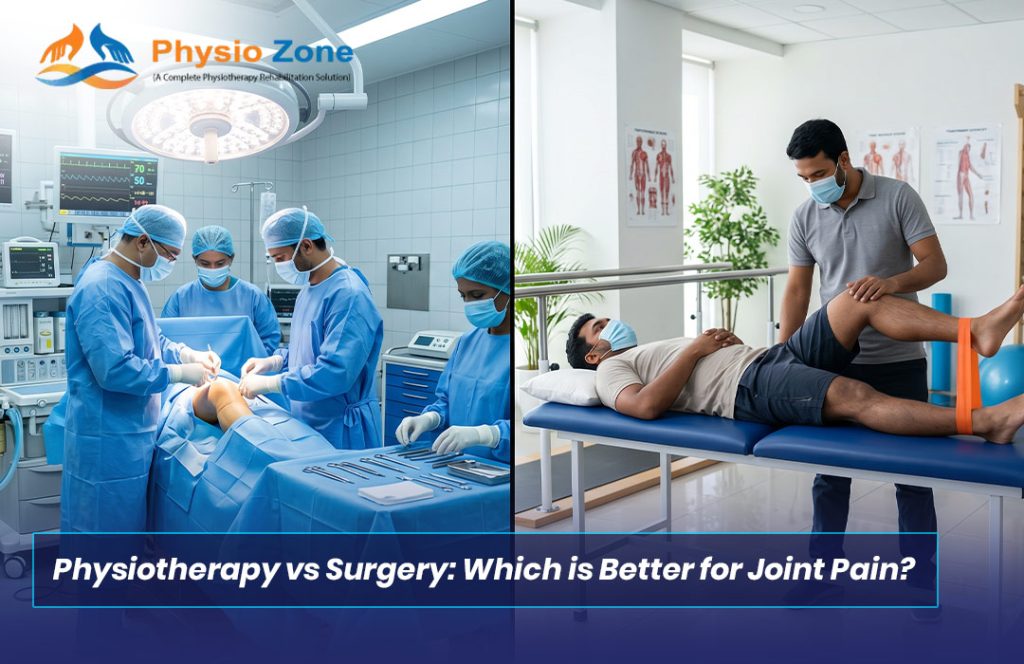
Joint pain affects millions of people worldwide, from a young athlete with a knee injury to an older adult living with arthritis. When the pain becomes persistent and starts limiting daily life, the question almost always comes up: should I try physiotherapy, or do I need surgery?
The honest answer is that there is no single right answer for everyone. The best choice depends on the type and severity of the joint condition, your age, your overall health, and how much the pain is affecting your quality of life. This guide breaks down both options clearly so you can have a more informed conversation with your healthcare provider.
Understanding joint pain
Joints are the connections between bones that allow movement. The most commonly affected joints are the knee, hip, shoulder, and spine. Pain in these areas can come from many different causes.
Common causes of joint pain
- Osteoarthritis (wear and tear of cartilage over time)
- Rheumatoid arthritis (an inflammatory autoimmune condition)
- Ligament or tendon injuries from sports or accidents
- Meniscus tears in the knee
- Rotator cuff problems in the shoulder
- Post-fracture stiffness and pain
- Chronic lower back pain related to disc or facet joint problems
The cause matters greatly when deciding on treatment. A minor ligament strain responds very differently to treatment than advanced arthritis where the cartilage has almost completely worn away.
What is physiotherapy?
Physiotherapy, also called physical therapy, is a non-surgical approach to treating pain, weakness, and reduced movement. A qualified physiotherapist assesses the root cause of your problem and creates a personalised treatment plan that may include manual therapy (hands-on joint and soft tissue work), targeted exercises to strengthen the muscles around the joint, electrotherapy such as ultrasound or TENS, dry needling, and education on posture and movement habits.
Physiotherapy treats the whole person, not just the painful joint. The goal is to restore function, reduce pain, and prevent the problem from returning, all without a single incision.
Modern physiotherapy is evidence-based. Research published in leading medical journals consistently shows that for many joint conditions, structured physiotherapy programmes produce outcomes comparable to surgery, particularly in the short to medium term.
If you are in Dhaka and considering physiotherapy, the team at PhysioZone BD offers comprehensive assessments and individualised treatment plans designed around your specific condition and lifestyle.
What does surgery involve?
Joint surgery ranges from minimally invasive arthroscopic procedures (small incisions using a camera and thin instruments) to major operations like total knee or hip replacement. Surgery is generally recommended when structural damage is severe enough that it cannot be managed with conservative treatment.
Recovery from surgery almost always requires physiotherapy afterwards. Even the most successful operation cannot restore movement and strength on its own. The muscles around the joint weaken during immobilisation, and the body needs guided rehabilitation to return to normal function.
Surgery carries inherent risks including infection, blood clots, anaesthetic reactions, nerve damage, and the possibility that pain does not fully resolve. These risks are worth weighing carefully alongside the potential benefits.
Side-by-side comparison
Physiotherapy
- No surgical risks
- Can begin immediately
- Treats the cause, not just symptoms
- Builds long-term strength and stability
- Generally lower cost
- Improves overall mobility
- No recovery downtime from procedures
Surgery
- Necessary for severe structural damage
- Can correct mechanical problems directly
- May provide faster relief in select cases
- Longer initial recovery period
- Higher cost overall
- Requires post-op physiotherapy anyway
- Outcomes vary by condition and age
When physiotherapy works best
Physiotherapy is often the recommended first-line treatment for a wide range of joint conditions. Research and clinical guidelines support starting with physiotherapy in the following situations.
Early to moderate osteoarthritis
For knee and hip osteoarthritis that has not yet reached the bone-on-bone stage, supervised exercise therapy and manual physiotherapy can significantly reduce pain and improve walking ability. Multiple large studies, including trials from the UK and Australia, have found that physiotherapy achieves outcomes similar to arthroscopic surgery for knee arthritis, without the recovery period or risks.
Rotator cuff injuries
Many partial and even full-thickness rotator cuff tears can be managed successfully without surgery. A progressive strengthening programme targeting the shoulder muscles often leads to full return of function. Surgery is typically considered only when physiotherapy has not produced improvement after three to six months of consistent treatment.
Chronic lower back and hip pain
The vast majority of back and hip pain cases, including those involving disc issues and facet joint problems, respond well to physiotherapy. Core strengthening, postural correction, and manual therapy form the foundation of effective non-surgical management.
Sports injuries
Grade one and two ligament sprains, muscle strains, and minor cartilage irritation in athletes are almost universally treated with physiotherapy first. Even anterior cruciate ligament (ACL) tears, once considered an automatic surgical case, are now managed non-surgically in many patients who do not participate in pivoting sports.
Not sure whether your joint pain requires surgery? The experienced physiotherapists at PhysioZone BD can assess your condition and guide you toward the right treatment path.
When surgery may be necessary
There are genuine situations where physiotherapy alone is not enough. Surgery becomes the appropriate choice in the following circumstances.
Severe structural damage
When imaging shows complete cartilage loss (bone-on-bone arthritis), a fully ruptured tendon, or a severely fractured joint surface, surgery is often the only way to restore function. A total knee or hip replacement, for example, removes the damaged joint surfaces and replaces them with prosthetic components. No amount of physiotherapy can grow new cartilage or repair a completely ruptured tendon on its own.
Mechanical instability
If the joint is unstable because of a torn ligament that is unlikely to heal, and the person is active or young, surgical reconstruction is usually recommended. This is common in complete ACL tears in athletes who wish to return to competitive sport.
Physiotherapy has been tried and failed
When a patient has completed a full, supervised course of physiotherapy over several months and there has been little improvement, surgery becomes a more justified option. This is why most surgeons and clinical guidelines recommend a trial of conservative treatment before surgical intervention.
Significant nerve compression
Severe disc herniation that is compressing a nerve and causing significant weakness, numbness, or loss of bladder and bowel control requires urgent surgical assessment. These are serious situations where delay can cause permanent nerve damage.
The role of physiotherapy after surgery
This is an aspect of the debate that is often overlooked: even if surgery is the right choice, physiotherapy remains essential. Post-surgical rehabilitation is not optional. Without it, the joint will not regain its full range of motion, the surrounding muscles will stay weak, and the risk of re-injury remains high.
A well-structured post-operative physiotherapy programme typically begins within days of surgery. The physiotherapist guides the patient through progressive exercises to restore movement, reduce swelling, rebuild strength, and retrain the body for normal walking, climbing stairs, and returning to sports or work.
In many ways, the quality of post-surgical physiotherapy determines the final outcome of an operation more than the surgery itself. Choosing a skilled physiotherapist for your recovery is as important as choosing your surgeon.
If you have recently had joint surgery in Dhaka or are planning to, the rehabilitation team at PhysioZone BD offers structured post-operative programmes tailored to your surgical procedure.
Questions to ask your doctor or physiotherapist
Before deciding on any treatment
- What is the exact diagnosis and how severe is the structural damage?
- What does the research evidence say about physiotherapy versus surgery for this specific condition?
- Have I completed a proper trial of physiotherapy before surgery is recommended?
- What are the realistic risks and success rates of the proposed surgery?
- How long will recovery take with physiotherapy alone compared to surgery plus rehabilitation?
- What happens if I choose physiotherapy and it does not work? Can I still have surgery later?
- What can I realistically expect from each option in terms of pain relief and function at one year?
Frequently asked questions
Is it safe to try physiotherapy before surgery?
In the vast majority of cases, yes. A conservative trial of physiotherapy does not worsen surgical outcomes if you eventually need the operation. Clinical guidelines for most joint conditions, including the knee and hip, recommend physiotherapy as the first step unless there are signs of serious structural damage or nerve compression requiring urgent intervention.
How long does physiotherapy take to show results?
This depends on the condition. Many people notice meaningful improvement within four to eight weeks of consistent treatment. A full course for moderate joint conditions typically spans three to six months. Chronic conditions or post-surgical rehabilitation may take longer.
Can physiotherapy replace joint replacement surgery?
For many patients with early to moderate arthritis, physiotherapy can delay or even avoid the need for joint replacement. However, for those with severe bone-on-bone arthritis who are significantly limited in daily life, joint replacement is often the most effective solution, and physiotherapy plays a critical role in the recovery afterwards.
Does physiotherapy work for elderly patients?
Yes, and often very effectively. Physiotherapy is generally safer for elderly patients than surgery because of the lower risk profile. Exercises are adapted to individual capacity, and the benefits, including improved balance, strength, and reduced fall risk, are well documented in older populations.
Where can I get physiotherapy in Dhaka?
PhysioZone BD provides expert physiotherapy services in Dhaka. You can reach out to their team for an assessment and personalised treatment plan through their contact page.
Final verdict
For most people with joint pain, physiotherapy should be the first treatment tried. It is safe, evidence-based, and highly effective for a wide range of conditions without the risks and recovery demands of surgery. Surgery becomes appropriate when structural damage is severe, when physiotherapy has been genuinely tried and has not worked, or when there is a specific mechanical problem that can only be corrected surgically. Even then, physiotherapy is a critical part of the recovery. The two approaches are not opposites. In many cases, they work best together.
If you are uncertain about which path is right for your joint pain, the best starting point is a professional physiotherapy assessment. A skilled physiotherapist can examine your condition, review your imaging, and give you an honest opinion on whether conservative management is likely to work or whether surgical referral is the appropriate next step.
Ready to take the first step toward less pain and better movement? Get in touch with the physiotherapy specialists at PhysioZone BD in Dhaka for a full assessment.